Legal Education According to European Standards: German “Gutachtenstil” Methodology for Legal Analysis in EU Law Case Studies
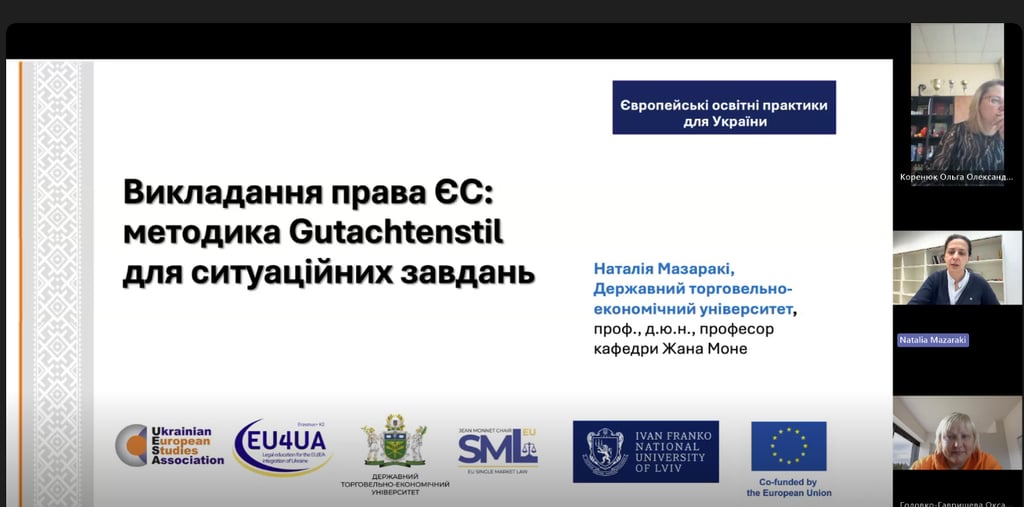
Within the framework of reforming Ukrainian legal education, little attention is paid to the methodology of teaching legal disciplines in general and EU law in particular, even though methods of law and teaching methodologies are of great importance for the European Union’s legal system, specifically for the uniform application of EU law. On March 26, 2026, Professor of the Jean Monnet Department at the State University of Trade and Economics (SUTE), Doctor of Law Natalia Mazaraki presented the Gutachtenstil methodology as a key tool for teaching EU law during an event organized by the Ukrainian European Studies Association and aimed at implementing European educational practices in Ukraine. The Gutachtenstil methodology (“legal opinion style”) is the foundation of the German legal school, which allows students to analyze complex legal situations step by step, applying specific facts to legal norms. Unlike the popular Anglo-Saxon IRAC model, the German approach is characterized by a higher degree of formalization and a detailed examination of each element of a legal norm against the facts of the case. The introduction of the Gutachtenstil methodology into Ukrainian legal studies will allow for the application of the “hypothesis-legal definition-application of legal norms to the facts of the case-conclusion” approach to education and will prepare Ukrainian lawyers in accordance with advanced educational practices.
“Gutachtenstil – is not just a form of writing; it is a way of thinking. It teaches future lawyers to distinguish the essential from the secondary and to construct logical chains that cannot be refuted. This is precisely the level of analysis expected of Ukraine in the process of integration into the EU legal framework,” notes Prof. Natalia Mazaraki. Of particular importance in the application of this methodology are the assessment criteria, where work is evaluated not on the correctness of the conclusion, but on the quality of the argumentation, specifically through the ability to identify central legal issues, construct arguments logically, and properly apply the legal framework to the specific circumstances of the case.
The event took place as part of the implementation of the Erasmus+ program projects “Modernization of Legal Education to Support Ukraine’s European and Euro-Atlantic Integration (EU4UA)” (coordinator – Ivan Franko National University of Lviv) and the Jean Monnet Chair “EU Internal Market Law” (coordinator – State University of Trade and Economics).