VIII Winter School in European Studies
NEWSRE-ENGAGE 2024
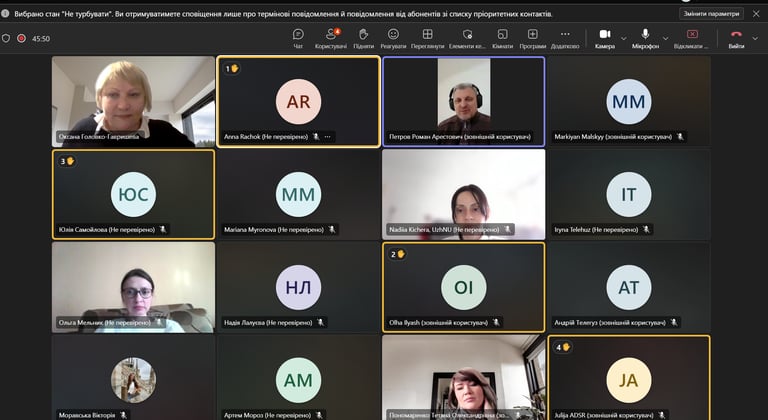
From February, 9 till February 13, 2026 the VIII Winter School in European Studies succesfully took place in the online format in the cooperation with the JMCE "Western Ukrainian Research Center for European Studies", JMCE of the National University "Kyiv-Mohyla Academy" and the EU Information Center of the Ivan Franko National University of Lviv. The VIII Winter School brought together leading scholars, experts and over 50 attendees from all parts of Ukraine and abroad for five days of in-depth discussions on European Union law, policies, and Ukraine’s EU accession process.
Being opened with welcoming remarks by Markiyan Malskyy, Dean of the Faculty of International Relations of the Ivan Franko National University of Lviv and Oksana Holovko-Havrysheva, UESA President (Ukraine). The VIII Winter School, the conceptual framework for in-depth discusssions on the backgrounds and challenges for the European integration in times of turbulence has been set-up. A session on the backgrounds and contemporary challenges of European integration delivered by Roman Petrov and Oksana Holovko-Havrysheva highlighted the contemporary defence, economic and geopolitic tensions. Participants were introduced to the foundations of the EU legal system, its institutional structure, and the concepts and models of EU common policies through lectures by Mykhailo Mykievych, Oksana Holovko-Havrysheva, and Oksana Krayevska.
The second day focused on the interaction between EU law and national legal systems. Enrico Albanesi (University of Genoa, Italy) addressed the complex relationship between EU law and domestic law. Further sessions examined the nature and sources of EU law, international treaties as sources of EU law, and decision-making procedures within the European Union. On the third day, attention shifted to key EU policies. Marina Keda explored EU migration policy and the Ukrainian diaspora. Oksana Holovko-Havrysheva discussed harmonisation of laws in the EU, while Vasyl Zelenko analysed EU economic policy and the regulation of competition within the EU internal market. The fourth day addressed EU regional, educational, and social policies, presented by Oksana Krayevska and Vasyl Zelenko. The programme concluded that day with a lecture by Nataliya Voytovych on countering propaganda and disinformation, highlighting both EU and global approaches.
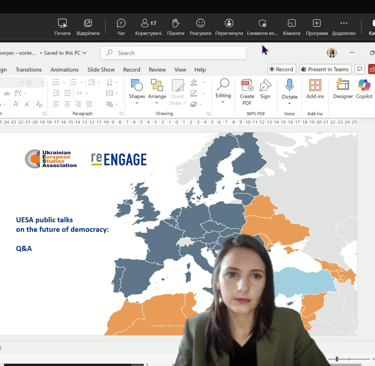
The final day combined academic reflection with practical engagement through the workshop “UESA Public Talks on Democracy,” led by Roman Petrov, Khrystyna Bidonko, and Sophie Gueudet and moderated by Oksana Holovko-Havrysheva. During this workshop the key findings of the research, conducted under the Horizon Europe project RE-ENGAGE were discussed and presented against similar researches, conducted in the Eastern Neighbourhood and in the Balkan states. The VIII Winter School concluded with expert lectures by Stefan Lorenzmeier (University of Augsburg, Germany) on the legal aspects of EU membership and by Adam Lazowski (University of Westminster, UK) on the state of play and challenges of Ukraine’s accession to the European Union, followed by a closing discussion session.
The VIII Winter School of European Studies once again provided a dynamic academic platform for dialogue, critical reflection, and exchange on the legal and political dimensions of European integration, reaffirming its role in fostering expertise on EU law and Ukraine’s European future.